Solitaire Cash
- 3.3
- Rating
- 100.00K
- Installs
- Free
- Price
 Analysis by App-foxy
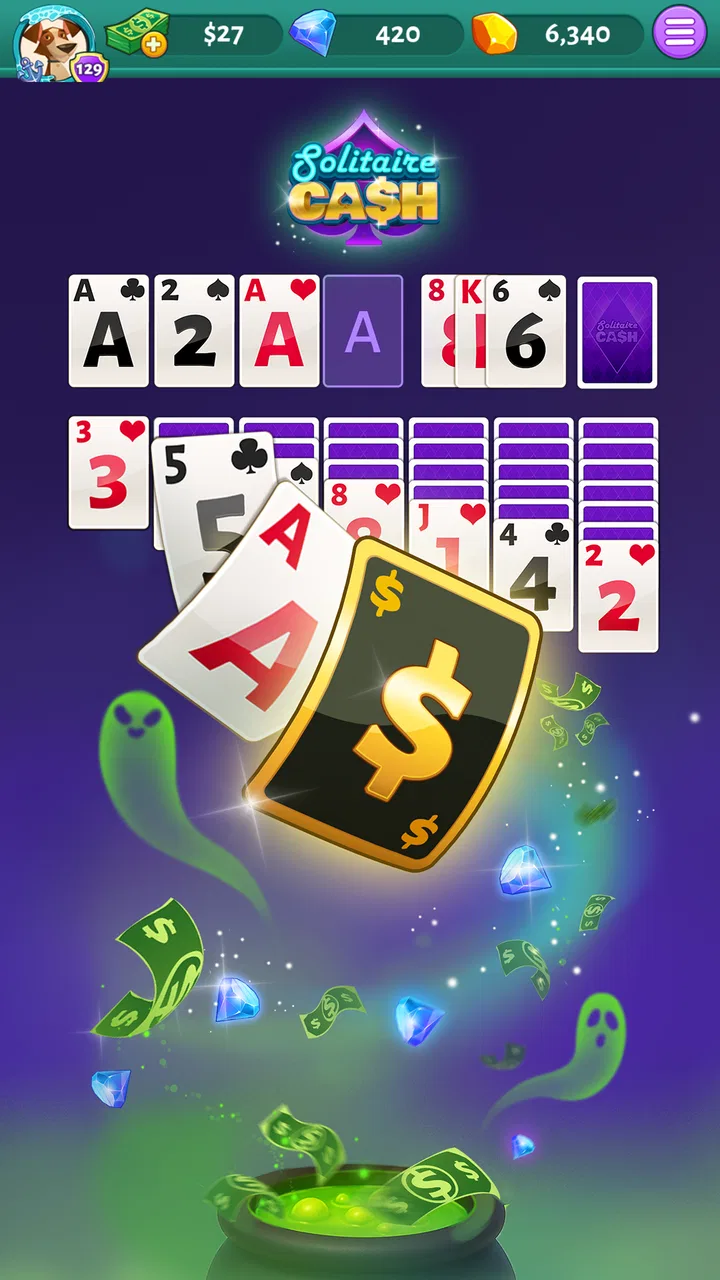
I usually turn to solitaire when I want something quiet, familiar, and easy to start without committing to a long session. Solitaire Cash takes that basic card-game comfort and places it inside a more competitive format. Developed by Papaya Gaming, it is a free card game built around skill-based solitaire and real-money play. That combination makes it more interesting than a standard offline solitaire app, but it also changes what I expect from every decision, every mistake, and every pause between games.
My first impression is that this is not really aimed at someone who only wants to pass time with no pressure at all. The traditional rules are approachable, yet the surrounding experience encourages me to think about speed, accuracy, and whether a particular game is worth entering. I can enjoy the recognizable card layout, but I also have to treat each move as part of a larger contest rather than as a completely private puzzle.
The game is free to install, carries an Everyone content rating, and supports Android devices running version 9 or later. It arrived on January 28, 2026, and the current version is 13.2.1. Those details make it accessible to a broad range of Android users, although accessibility should not be confused with suitability: the real-money element deserves more attention than the simple card format might suggest.
You May Also Like

 Blood Strike: 2.5 Anniversary
Blood Strike’s Loadouts Turn Every Drop Into a Tactical Gamble
A close look at Blood Strike’s custom loadouts: how fast access to signature weapons reshapes its battle royale rhythm, rewards preparation, and narrows the gap between fights.

 Pandora - Music & Podcasts
Pandora’s Music Is Easy to Start, but Harder to Recover
Pandora’s strength is its low-effort path from a seed to a station. Its weak spot is how much confidence it asks you to place in connection, setup, and quiet recovery.

 8 Ball Pool
 Is Built on Rivalries, Rematches, and Routine
A close look at the rivalries, rematches, shared routines, and unanswered safety questions that turn a quick pool match into a persistent mobile community.

 Samsung Music
’s Quiet Strength Is Playing What You Already Own
Its reach comes less from spectacle than from dependable access to a personal library. That simplicity is both the app’s strongest retention engine and its ceiling.

 AccuWeather: Weather Radar
AccuWeather Review: A Quick, Clear Forecast for Everyday Decisions
For everyday plans, the best forecast is the one you can understand quickly. AccuWeather makes rain timing, radar, and local conditions easy to act on, with a few trade-offs.

 Hill Climb Racing
Why Hill Climb Racing Still Turns Crashes Into One More Run
A tiny car, a bumpy hill and one more upgrade: Hill Climb Racing keeps resurfacing because its simple chaos makes every near-miss feel personal.
More From Our News Desk
View All News


How the opening goals shape the first sessions
The early appeal comes from having a goal that is immediately understandable: arrange the cards successfully while making strong choices along the way. I do not need to learn a complicated collection of characters, a large map, or a long chain of tutorials before playing. That quick start is one of the strongest reasons to try it if ordinary solitaire already feels comfortable.
What changes the mood is the skill-based framing. In a normal solitaire app, I can undo a move, restart casually, or leave a game unfinished without feeling that I have lost anything meaningful. Here, I am more likely to examine the board before acting. A move that looks legal may still be poor if it blocks a useful card or removes an option I may need later.
That creates a practical early goal beyond simply finishing a layout: I want to reduce careless decisions. I found it more useful to slow down for the first few moves than to chase speed immediately. Opening a column or exposing a hidden card can be valuable, but only when it improves the number of future choices. Moving cards just because a legal destination appears is the kind of habit that feels harmless in relaxed solitaire and becomes costly in a competitive setting.
For a new player, I would suggest treating the first sessions as practice in reading the board. Look for moves that uncover information, preserve empty spaces for flexible cards, and avoid committing a sequence too early when another route may expose more of the layout. These are not flashy goals, but they give the game a sense of direction before any longer-term progress becomes important.
The real-money angle also introduces an early personal goal: decide what kind of player you are before entering anything that carries financial consequences. Some people will be interested in the competitive side, while others will prefer the card challenge itself. I think it is sensible to establish a strict entertainment limit and avoid treating a disappointing result as a reason to continue playing. The game can be enjoyable as a test of judgment, but it should not become a way to chase losses.
What feels rewarding before long-term progress
Solitaire Cash does not need a complicated reward structure to make the first few games engaging. The immediate feedback comes from finding a clean sequence, revealing a blocked card, or recovering from a position that initially looked awkward. Those moments are satisfying because they show that a better decision, rather than random tapping, changed the outcome.
I also like that the familiar card format keeps the learning curve focused on decisions instead of controls. A player who already knows common solitaire patterns can concentrate on planning. Someone returning to the genre after a long break may need a little time to rebuild the habit of checking all available moves before committing, but the basic interaction is not intimidating.
One useful routine is to separate “information moves” from “finishing moves.” An information move exposes a card or opens a new possibility. A finishing move sends a card toward its final destination but may reduce flexibility. Keeping those ideas separate helps me avoid rushing toward an apparently neat board while leaving important cards buried.
Progress signals, challenge, and the pace of play
The strongest progress signal in this kind of game is not a level number or a decorative collection; it is the quality of my decisions. I notice progress when I recognize dead ends earlier, preserve more options, and make fewer moves that need to be corrected. That makes the experience feel more skill-driven than a simple streak of lucky finishes.
At the same time, this kind of progress can feel less visible than the clear unlock systems found in many mobile games. If you need a steady stream of new locations, characters, equipment, or story chapters, the card table may seem restrained. The satisfaction comes from improving execution and handling pressure, not from watching a large world open up around you.
The pacing works best in short, focused sessions. Solitaire naturally supports picking up the phone for a few minutes, and the competitive context gives those minutes a clear purpose. I can play while waiting for an appointment or during a short break, but I would not describe it as mindless background entertainment. The more seriously I take the result, the more attention the game asks from me.
That distinction matters in an everyday situation. If I am sitting on a train and want to relax without caring about the outcome, a conventional solitaire app is probably the better choice. If I have a quiet break and want a compact challenge that rewards careful planning, this game feels more appropriate. The same card layout can serve both moods, but the possibility of real-money play makes the second mood much more natural.
The difficulty curve is also tied to decision quality rather than just the appearance of harder cards. A board can look manageable and still become difficult because an early choice removed flexibility. I found that the most challenging moments were not necessarily the busiest ones; they were the positions where several moves looked acceptable and only one preserved a realistic route forward.
That is where patience becomes a practical advantage. I try to scan the entire layout before making the first move, identify cards that are currently blocking access, and avoid assuming that the first available sequence is the best one. On a phone, it is easy to tap quickly and lose track of the larger arrangement. Taking a brief pause before a major move is a small habit, but it improves the experience considerably.
Where the challenge can become uncomfortable
The competitive structure can make ordinary variance feel more significant. Even when I make sensible choices, a game may not develop in the way I hoped. In a relaxed solitaire app, that is simply part of the puzzle. In a real-money environment, the same uncertainty can create frustration because the emotional weight of the result is higher.
This is the main limitation I would explain to a friend. The skill-based format is appealing, but it does not turn every outcome into a pure test of ability. Card games still involve situations that may not resolve in my favor, and I need to be comfortable with that before playing competitively. Anyone looking for a completely predictable skill ladder may prefer a puzzle game with fixed levels instead.
Another trade-off is the balance between speed and thoughtfulness. Playing too slowly can make a short session feel heavy, while playing too quickly encourages mistakes. I found the best rhythm by planning the next meaningful sequence rather than calculating every harmless move. That keeps the game moving without turning the whole experience into frantic tapping.
The developer, Papaya Gaming, has positioned the game in a space where the familiar rules are only part of the appeal. The surrounding pressure is what separates it from a basic solitaire download. That can sustain interest for players who want competition, but it may reduce the calming quality that originally attracts people to solitaire.
Retention pressure and the question of who should play
The game’s ability to keep me engaged comes from the desire to make a better decision in the next round. A close result can make me review where I committed too early, while a successful run can encourage me to test whether I can repeat the same quality of play. This is a more focused form of retention than collecting items or following a story, and it will appeal most to people who enjoy self-improvement through repetition.
There is also a natural tension between stopping after a satisfying game and continuing because the next one might go better. That tension is not automatically a flaw, but it deserves conscious handling when money is involved. I recommend deciding in advance how long I want to play and how much I am willing to risk, then stopping when that limit is reached rather than negotiating with myself after a poor result.
For that reason, I would not recommend this game to children simply because its content rating is Everyone. The cards themselves are family-friendly, but the real-money aspect is a separate consideration for parents and guardians. Adults should also check whether this style of play fits their own local rules and personal boundaries before using the competitive features.
It is a good match for an experienced solitaire player who wants more consequence behind each move, someone who enjoys compact contests, or a player who likes analyzing mistakes after a round. It is less suitable for anyone who wants a fully offline, no-pressure pastime, a rich progression system with frequent unlocks, or a game where every failure can be retried without emotional or financial weight.
Compared with the usual free solitaire alternatives, this title has a sharper sense of purpose. A standard app is often better for relaxation, unlimited experimentation, and casual play. Solitaire Cash is more compelling when I want my decisions to matter within a competitive setting. The trade-off is that the ordinary alternatives generally feel safer for long, unfocused sessions because there is no reason to chase a better result.
One of the most useful ways to approach it is to keep two mental modes separate. In practice mode, I can focus on recognizing patterns and improving my card management. In competitive play, I should use only the habits I have already tested and avoid experimenting recklessly. Mixing those modes is where many avoidable mistakes begin: a move that is interesting during practice may be irresponsible when the result carries greater consequences.
Small habits that make the card table clearer
I recommend checking the less obvious move before taking the obvious one. A visible card that can move immediately may not be the priority if another move uncovers a blocked card or creates a more useful empty space. This simple comparison often matters more than speed during the opening of a game.
I also try to avoid building a long sequence simply because it looks tidy. A neatly arranged stack can hide the fact that I have reduced the number of cards I can access. Keeping flexibility is especially important when several columns depend on the same rank or suit pattern. The best board is not always the one that looks most organized; it is the one that leaves me with the most workable choices.
Finally, I treat a losing round as a review opportunity only once. I can identify the key mistake, adjust my approach, and move on. Replaying the same decision emotionally is rarely as useful as changing the habit that caused it. This mindset helps preserve the skill-based appeal without letting the result control the rest of my session.
My verdict on the progression and overall fit
Solitaire Cash succeeds when I judge it as a focused competitive card game rather than as a decorative version of ordinary solitaire. Its early goals are easy to understand, its challenge comes from planning under pressure, and its pacing suits short sessions where I want a clear mental task. The most meaningful progress is learning to preserve options and make fewer impulsive moves.
Its retention design is strongest for players who enjoy repeating a familiar format in search of better execution. I can see why the game has attracted a growing audience: it has passed fifty thousand installs and holds an average rating of 3.9 from around 389 ratings, with roughly 124 written reviews. Those figures suggest real interest while also leaving room for mixed experiences, which matches my view that the game’s appeal depends heavily on how comfortable a player is with competitive, real-money play.
The free entry point makes it easy to try, but it should not be interpreted as a promise of risk-free entertainment. The card mechanics are accessible, while the surrounding stakes require maturity and self-control. I would approach the game with a fixed budget, a time limit, and the willingness to use it only as entertainment rather than as a source of income.
My final recommendation is therefore selective. If you already enjoy solitaire and want a more intense version where planning, timing, and discipline matter, this is worth exploring. If your ideal card game is quiet, consequence-free, and endlessly forgiving, I would choose a traditional solitaire alternative instead. For me, the progression verdict is positive but conditional: the game sustains play through improving judgment, not through a large world of unlocks, and that focused design is either its biggest strength or its clearest limitation depending on what I want from a mobile card game.
FAQs for Solitaire Cash
01What is Solitaire Cash and how does it work?
Solitaire Cash is a mobile game that allows players to enjoy a classic card game experience while competing for cash prizes. The app matches you with other players of similar skill levels in tournaments where you can win real money. The game is free to play, but entering cash tournaments requires a deposit.
02Is Solitaire Cash safe and legal to use?
Yes, Solitaire Cash is safe and legal to use in regions where skill-based gaming is allowed. The app uses secure payment systems and complies with local regulations. However, it’s important to check the legality in your area, as some states or countries may have restrictions on cash-based gaming.
03How do I deposit and withdraw money in Solitaire Cash?
Depositing money into Solitaire Cash is straightforward and can be done via various payment methods like credit cards or PayPal. Withdrawals are processed through the same method used for deposits. The app aims to process withdrawals quickly, but it may take a few business days for funds to appear in your account.
04What are the main features of Solitaire Cash?
Solitaire Cash offers a variety of features including multiplayer tournaments, daily challenges, and leaderboards. The app is designed with an intuitive interface and vibrant graphics to enhance the gaming experience. Players can also enjoy practice rounds for free, allowing them to improve their skills before entering cash competitions.
05Can I play Solitaire Cash on both Android and iOS devices?
Yes, Solitaire Cash is available for both Android and iOS devices. The app is optimized to run smoothly on most smartphones and tablets, providing a consistent experience across platforms. Ensure your device meets the minimum system requirements for the best performance.
Pros
- Smooth gameplay without lag.
- User-friendly interface design.
- Low battery consumption.
- Engaging daily challenges.
- Secure payment and withdrawal options.
Cons
- Limited free game entries.
- Ads can be intrusive at times.
- Requires constant internet connection.
- In-app purchases can get pricey.
- Occasional matchmaking delays.

Solitaire Cash
Gallery